
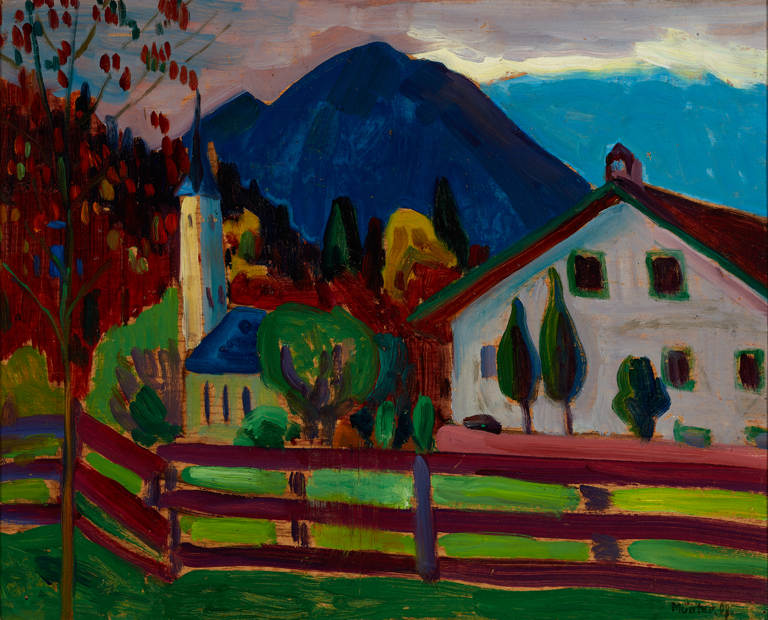
Oberau (Landscape), 1908
Oil on board
12 3/4 × 16 in. (32.39 × 40.64 cm) framed: 19 3/4 × 23 × 1 1/2 in. (50.17 × 58.42 × 3.81 cm)
Maurice and Esther Leah Ritz Collection M2004.131
Photo credit: John R. Glembin
© Artists Rights Society (ARS), New York / VG Bild-Kunst, Bonn
Objectives:
- Students will understand the relationship between multiplication and division.
- Students will use known strategies to solve word problems with a real world context.
- Students will solve an ‘equal groups’ style division word problem.
Wonder:
- What do you see in this image?
- What stands out to you?
- What is in the foreground?
- What is in the background?
- What do you notice about the fence?
- Wat is unique about it?
Propose:
- “Notice how the fence kind of curves and meets at unique angles. We can see that the fence is made up of different wood panels or logs. How many logs go horizontally to make up this fence?
- Have students consider the following word problem:
- A man is building a fence around his home, much like the one i the painting. He has 36 logs to get him started. He knows that each panel requires 3 logs. How many panels of fencing can he create for now?
Do:
- Students will perform the task, using known strategies, specifically drawings and equations.
- Example of work produced:
- ? x 3 = 36
- 12 x 3 = 36
- ? = 12
- Example of work produced:
Share:
- With your turn and talk partners, discuss the following:
- What operation could we use to solve this problem?
- How can we write an equation that shows this situation?
- How could we make a drawing to help us out?
- How did you solve this problem? Was it different from your partner?
- Discuss as a class:
- How can we use a multiplication equation to solve this problem?
- How can we use a division equation to solve?
Standards:
- Represent and solve problems involving multiplication and division.
- M.3.OA.A.3 Use multiplication and division within 100 to solve word problems in situations involving equal groups, arrays, and measurement quantities, e.g., by using drawings and equations with a symbol for the unknown number to represent the problem.
- Understand properties of multiplication and the relationship between multiplication and division.
- M.3.OA.B.5 [WI.2010.3.OA.B.6] Understand division as an unknown-factor problem. For example, find 32 ÷ 8 by finding the number that makes 32 when multiplied by 8.