
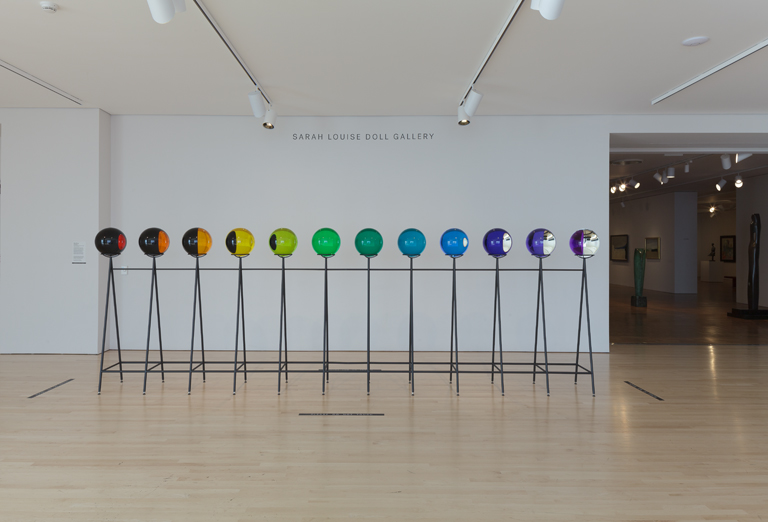
Rainbow Bridge, 2017
Painted and mirrored glass with powder-coated steel
66 9/16 × 195 1/4 × 19 11/16 in. (169 × 496 × 50 cm)
Purchase, with funds from the Contemporary Art Society, Jeffrey Yabuki, Donna and Donald Baumgartner, Sue and Bud Selig, Herzfeld Foundation, Steve and Janice Marcus, Ken and Kate Muth, Flavius Cucu and Miriam Van de Sype, Jason and McKenzie Edmonds, Tim and Sue Frautschi, Lincoln and Lilith Fowler, Mark and Judy Garber, Michael and Jennifer Keough, Joan Lubar and John Crouch, Justin and Susanna Mortara, Buddy and Catherine Robinson, Christine Symchych and James McNulty, and friends of the Contemporary Art Society M2017.126
Photo credit: John R. Glembin
Objective: Students will observe the painting and explore how the moon appears in the sky at
night and how it can change over time. Students will connect their observations with their
understanding of the different phases of the moon, this includes how the moon’s appearance
changes based on the position to the earth and sun
Look: Students will then observe the painting and ask themselves what they notice about the
different shaded areas and what phase of the moon it can represent. Students can look at the
darkness and shape of the shaded areas and how it connects to the moon phases.
Wonder: Students can think about questions like why the moon looks full and why it can be
only partly visible, or what phases of the moon fit to this painting. Students can also wonder how
the phases of the moon can be recognized either by shape, darkness, or when the phase occurs,
and how visible each phase can be to humans?
Share: Students can create a diagram showing each phase of the moon. Then students can share
their work by explaining what they learned about the phases of the moon. As students show their
work they can answer questions like why the moon changes shape, when does the moon change
shape, how does sunlight affect what we see and what is the impact of the moon.
Standard: SCI.ESS1.B.5 The Earth’s orbit and rotation, and the orbit of the moon
around the Earth cause observable patterns.