
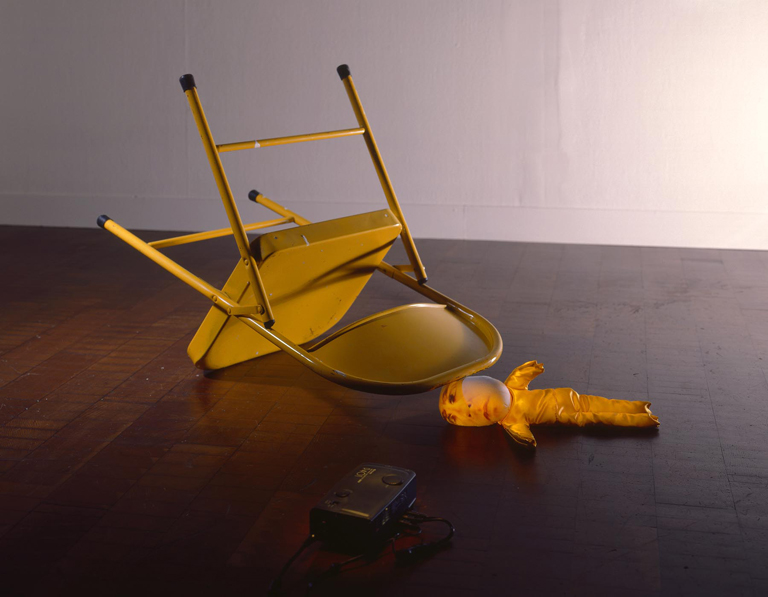
VIDEO ART*
Oursler, Tony
American, b. 1957
1996
Video installation with video projector, VCR, video tape, small cloth figure, and metal folding chair
Dimensions variable
Purchase, with funds from Donald and Donna Baumgartner, Marianne and Sheldon B. Lubar, Allen and Vicki Samson, Dr. and Mrs. Philip Shovers, and Sibyl and David Wescoe
(M1998.136a-i)
Objective: Students will observe visual media and consider how scientists measure and collect data for something they can’t directly observe, such as personality. They will connect their observations to analyzing data, identifying bias in data collection, and recognizing patterns in responses/data.
Look: Students will examine MMPI (Self-Portrait in Yellow) and listen to the audio. Explain that the artist is reading questions from the Minnesota Multiphasic Personality Inventory (MMPI), a psychological test used to help assess mental health. What is the audio saying? How does this piece make you feel? What do you notice about the types of questions being read? Why might scientists use questions like these?
Write: In small groups of 3-4, students will create at least five questions that could be used to measure an aspect of personality. Encourage students to think about whether the question could produce useful data.
Share: Groups will exchange their questions with another group; each student in the group will answer the questions. Once they are done, they will exchange their questions once again. After collecting the response, each group will look for patterns in the answers and identify if they have measurable data. What questions worked best? What questions need improvement?
Standard: MS-ETS1-3. Analyze data from tests to determine similarities and differences among several design solutions to identify the best characteristics of each that can be combined into a new solution to better meet the criteria for success.