
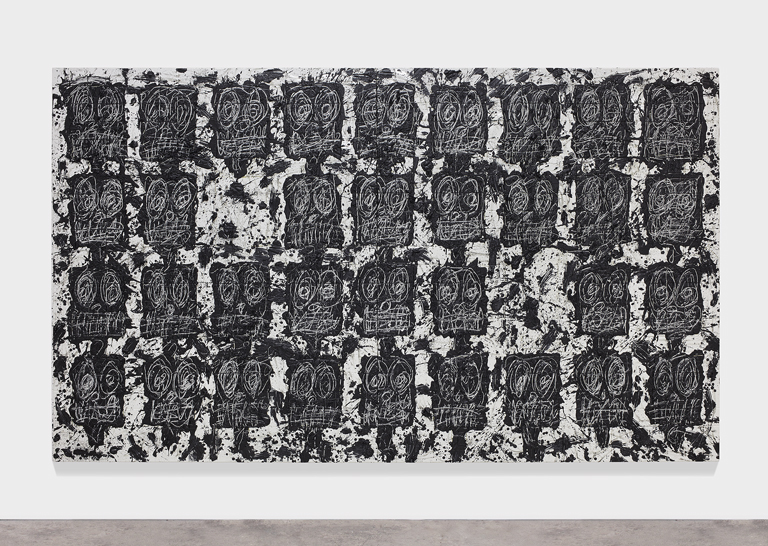
Untitled Anxious Audience, 2017
Ceramic tile, soap, and wax
95 1/2 × 159 × 2 1/2 in. (242.57 × 403.86 × 6.35 cm)
Purchase, with funds from Mark and Debbie Attanasio, Marianne and Sheldon Lubar, Joanne Murphy, the African American Art Alliance, and the Modern and Contemporary Art Deaccession Funds M2017.60
Photo credit: Martin Parsekian
© Rashid Johnson
Objective: Students will understand arrays as equal groups arranged in rows and columns and use this structure to represent multiplication. Students also begin to recognize when the structure is incomplete and apply subtraction to accurately determine the total.
Look: Ask students to observe the artwork silently for 1 minute. Prompt students to think about what they see.
- What stands out to you?
- What does it look like to you?
- What does the whole thing show? What about individually?
Allow students 1 minute to turn and talk about what they see.
Wonder: Move into guided discussion/observation.
- What do you see? Is there anything repeating?
- Are the faces organized? How?
- Can you see rows and columns?
- What is missing?
Model: Model and build the mathematical thinking with students through think-alouds.
- Say: Even though some faces are missing, we can still see the structure of an array.
- Ask:
- Are all the rows complete?
- If this array were complete, how many rows would there be?
- How many faces in each row?
We can see an array of faces with 4 rows of 9 faces each.
- Think aloud
- 4 rows x 9 faces = 36 faces
Refer back to the missing faces.
- Ask:
- Is the total 36 faces?
- How many faces are we missing?
- If the full array were 40, but 2 are missing, what do we do?
- Think aloud
- 36 total – 2 missing = 34 faces
Apply: Students design their own array artwork. Perform a gallery walk to display.
Standards: M.3.OA.A.1 – Interpret products of whole numbers, e.g., interpret 5×7 as the total number of objects in 5 groups of 7 objects each.
M.3.OA.A.3 – Use multiplication and division within 100 to solve word problems in situations involving equal groups, arrays, and measurement quantities, e.g., by using drawings and equations with a symbol for the unknown number to represent the problem.