
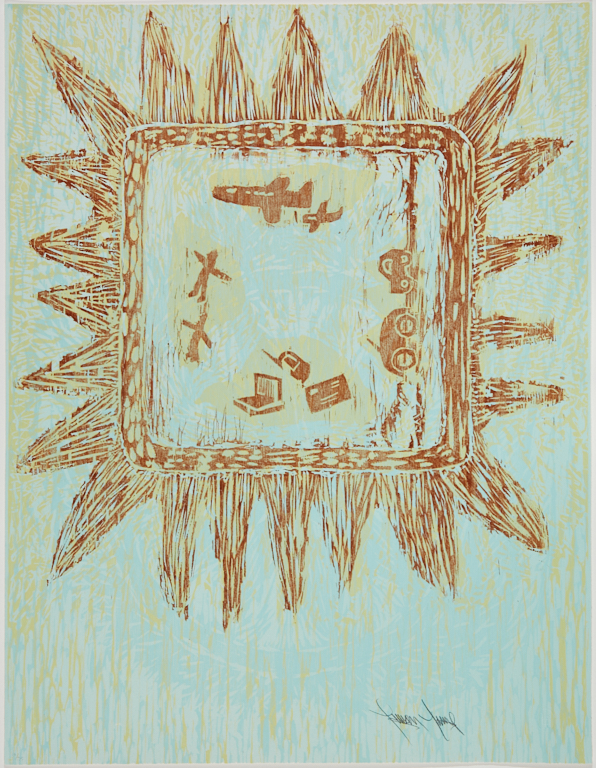
Untitled, from the portfolio Lasting Impressions, 2001
Color woodcut
block and sheet: 26 × 20 in. (66.04 × 50.8 cm)
Purchase, David C. Scott Fund M2001.92.4
Photo credit: John R. Glembin
© Estate of Truman T. Lowe
Objective: Students will observe details in a piece of artwork and develop a scientific
theory about what is happening using evidence from the artwork.
Look: Have students spend several minutes closely observing Untitled. Encourage them
to notice anything and everything about the art piece. Ask students guiding questions:
What do you notice? What symbols or objects do you see that might fly? What shapes or
patterns do you notice that show clues of motion? What do you think is happening in this
picture? Briefly introduce the concept of motion and how it is a concept where a force
causes an object to change its location.
Write: Begin with prompting the question: What forces might affect objects in motion?
Have a few students share their ideas. Students will use their science notebooks to
respond to the following prompts independently:
What flying or moving objects do you see in this picture?
How do you think those objects move?
Write one question you have about motion.
See: Once students are finished completing the questions, students will be placed
together in small groups (3 students). Each group will get 30 seconds to observe the
artwork piece again. With their groups, students will create a scientific theory about what
is happening in the artwork. At the end, groups will present their theory and evidence to
the group and defend their theory.
Standards: SCI.SEP1.A.3-5 Students ask questions that specify qualitative relationships.
SCI.SEP3.3-5 Students plan and carry out investigations that control variables and
provide evidence to support explanations or design solutions