
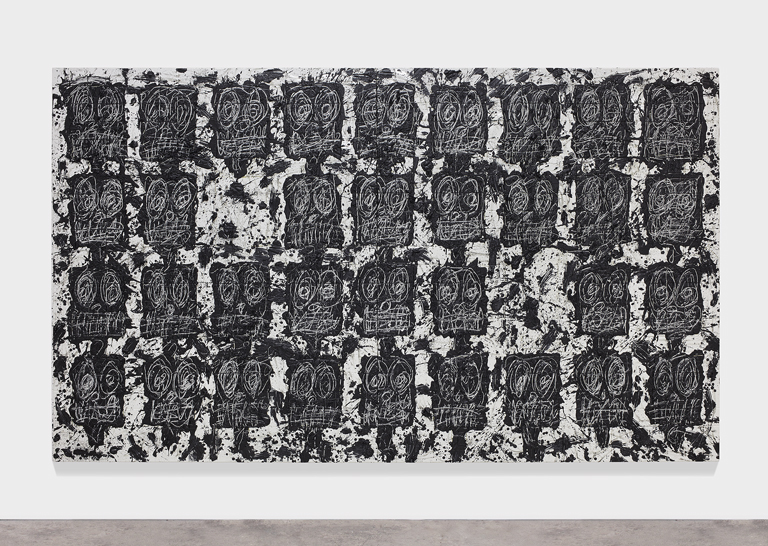
Untitled Anxious Audience, 2017
Ceramic tile, soap, and wax
95 1/2 × 159 × 2 1/2 in. (242.57 × 403.86 × 6.35 cm)
Purchase, with funds from Mark and Debbie Attanasio, Marianne and Sheldon Lubar, Joanne Murphy, the African American Art Alliance, and the Modern and Contemporary Art Deaccession Funds M2017.60
Photo credit: Martin Parsekian
© Rashid Johnson
Objective: Students will be able to explain and justify their method for finding the total number
of tiles in an array and compare it to other strategies.
Look: Students observe the artwork, noticing the different textures and shapes. Do you see
any patterns or repeated shapes? Do you notice anything irregular in the pattern? Is there a
way we could find out how many shapes there are?
Write: Students write down how many tiles they believe there are, and how they found that out.
If they finish, try solving another way. What do we know about the array to help us solve it? Is
this a one step problem? Did you get the same answer using different ways? What are you
using to solve?
Share: First, have students share their method of solving to a partner so each student has a
chance to defend their answer. Then, facilitate a math talk about the artwork. Some students
will share their method of solving and justify their process. How many tiles are there? How did
you get that answer? What operation(s) did you use? Did you and your discussion partner
agree?
Standard: M.3.OA.A.1 Interpret products of whole numbers, e.g., interpret 5 x 7 as the total
number of objects in 5 groups of 7 objects each.
For example, describe a context in which a total number of objects can be expressed as 5 x 7.