
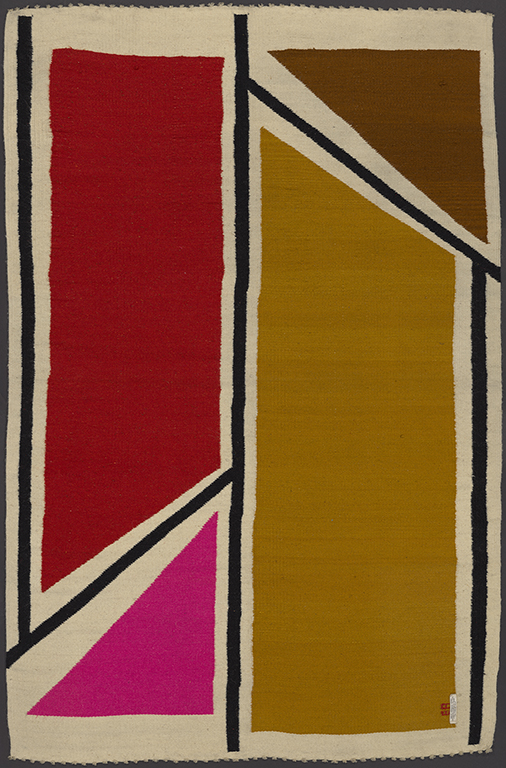
Objective: Students will identify geometric shapes, patterns, and symmetry within the artwork Aerial View and use mathematical vocabulary to describe what they notice.
Look: Have students spend several minutes closely observing Aerial View. Encourage them to notice everything, from large shapes to smaller details, textures, and how lines and colors interact. Ask them to think about the different types of shapes they see, such as triangles, rectangles, squares, or circles. The title Aerial View can help guide their thinking. Ask students to imagine looking at a city, fields, or nature from above and consider how the shapes and patterns might reflect that perspective.
Write: After observing, students will write detailed notes about what they notice in the artwork. They should describe shapes, lines, and patterns and how these elements interact to create repetition or symmetry. For example, a student might write, “I see a row of four rectangles lined up horizontally. They look like rooftops of buildings.” Encourage students to use math vocabulary such as parallel, pattern, and shape. They can also draw quick sketches of the shapes or patterns they see, labeling each one to make their observations clearer. The goal is for students to explain not just what they see, but how the shapes and lines relate to one another and contribute to the overall design.
Share: Students will form two circles, one inside and one outside, so that each student faces a partner. Each student will take turns sharing one observation about the shapes, lines, or patterns they noticed in the artwork. After both students have shared, the outside circle will rotate a few spots to meet a new partner. This process continues until students have shared with several peers. While listening to their partners, students should compare observations, making note of any similarities or differences, and think about new ideas or vocabulary they can use in their own descriptions.
Standard: 3.G.A.1 — Understand that shapes in different categories (e.g., rhombuses, rectangles, and others) may share attributes and that the shared attributes can define a larger category (e.g., quadrilaterals