
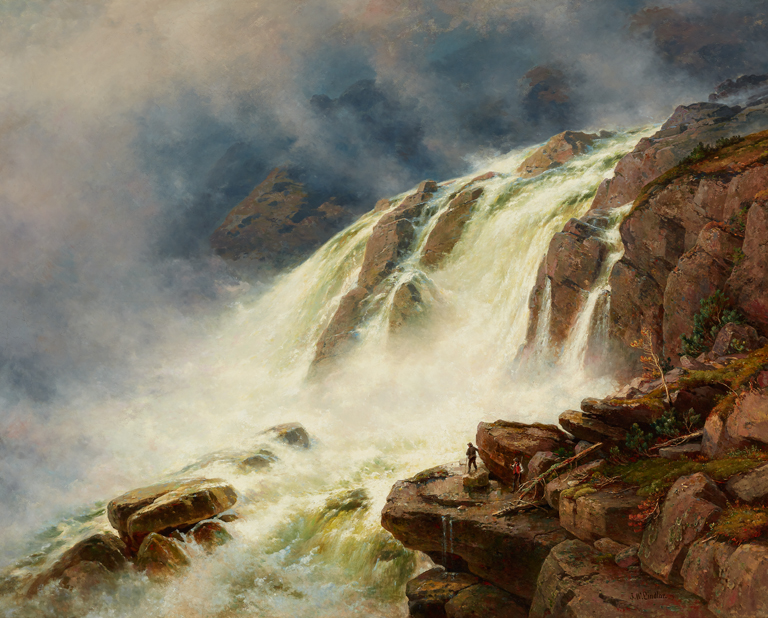
Waterfall in Norway, 19th century
Oil on canvas
50 × 63 in. (127 × 160.02 cm)
Gift of Marie K. Ingersoll and George L. Kuehn M1962.1159
Photo credit: John R. Glembin
Objective: Students will understand how rainfall and flowing water break down and move earth materials, and how this shapes the land and affects living things.
Look: Students will analyze the painting and respond to the guiding questions that get them thinking deeply about the painting.
- What do you notice about the water?
- How do you think the water affects the rocks and soil?
- What might happen to the land if the water keeps falling like this for a long time?
Wonder: Students will think about how water breaks rocks into smaller pieces and analyze how water makes objects move. Students will also analyze how long it takes for water to change the land, and how the changing of the land affects living things (plants and animals). Students will be observing the painting throughout the entire lesson and will be able to use t as a reference to support their thinking and thoughts/assumptions they have.
Share: Students will engage in a whole group discussion by responding to the given prompt, and they will have to explain their reasoning with scientific evidence from the picture or class resources.
- Prompt: how does water, like the waterfall we analyzed, change the land over time, and how do those changes affect living things?
Standard: SCI.ESS2.A.4 Rainfall helps to shape the land and affects the types of living things found in a region. Water, ice, wind, organisms, and gravity break rocks, soils, and sediments into smaller pieces and move them around.