
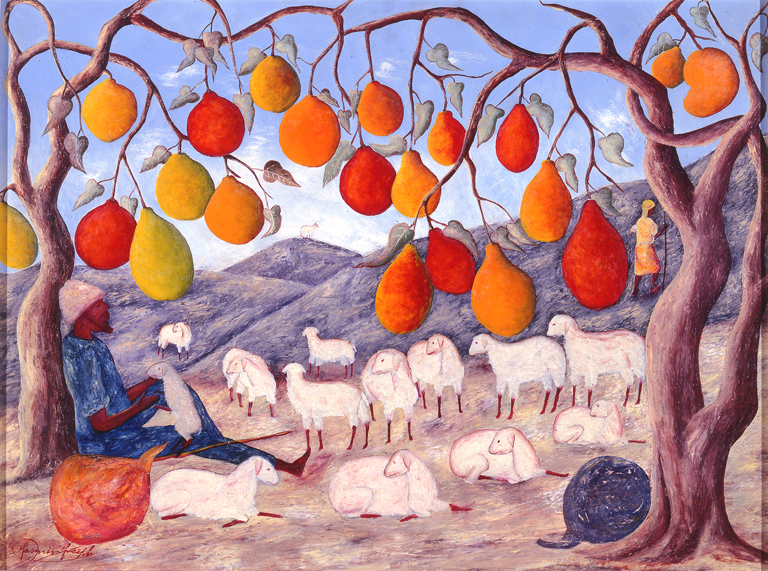
Objective: Students will be able to count objects in a group, categorize them into subgroups, and add these groups to find totals.
Look: Introduce the image to the students and have them look at it for a minute. Ask students what numbers do you see in the artwork? Clarify it isn’t literal written numbers, but numbers they can count. Don’t prompt them to see certain objects yet. Allow a turn and talk to see what numbers students are seeing. Guide the discussion with some of these questions: How many fruits are hanging on the tree? How many different colored fruits are there? How many types of objects are there? Are there more big objects or small objects?
Write: Write down the numbers you counted. For example: Number of sheep lying down. Number of sheep standing up. Now think, what equations could we make with these numbers? What addition equations could we create with the artwork? Example: Add the sheep lying down and standing. Sheep lying down + sheep standing = total sheep.
Share: In a turn and talk, compare your addition sentences and totals with a partner. Then as a class, share how your numbers come together to make a new total. Talk about the groups of sheep, fruits, or leaves you counted or drew. WAs their equation more or less than yours? Does it look like in the artwork that it is more? Discuss how even though there was not a single number written we are still able to see and use math with the world we see.
Standard: CCSS.Math.Content.2.NBT.B.5 Fluently add and subtract within 100 using strategies based on place value, properties of operations, and/or the relationship between addition and subtraction.