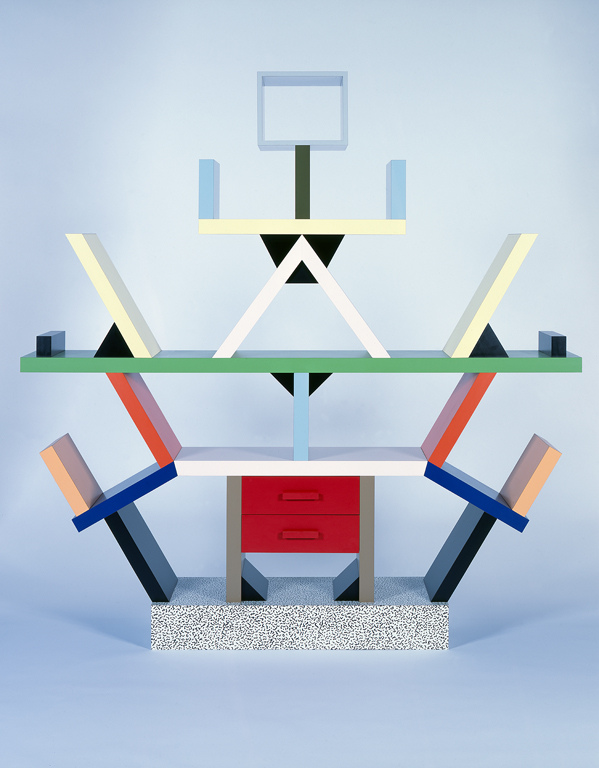
Objective: Students will observe a piece of art and identify the different shapes
they see. They will describe the shapes using mathematical language (sides,
angles, corners) and discuss how the shapes fit together to form the design.
Notice: Take a close look at the image. What stands out to you about how the
shapes are arranged? Can you spot any straight or curved lines? What kinds of
shapes do you recognize—triangles, rectangles, or maybe something else? Do any
parts of the design look the same on both sides?
Wonder: What questions come to mind as you look at the image? What do you
think this design might show or represent? How many different shapes can you
spot, and what kinds are they? Write your observations and questions on a piece
of paper. Be specific, note the types of shapes you see (triangles, rectangles,
circles, etc.) and any patterns or repetitions you notice. You can also jot down any
connections you make, such as where you might see similar shapes in buildings,
artwork, or nature.
Ask: Share your ideas with a partner about what you think the image might
represent. Compare the notes you wrote during the “Wonder” step and discuss
how the shapes and lines work together to create the overall design. Ask each
other questions like: What shapes did you find? How many of each shape can you
see? Do any of the shapes look balanced or symmetrical? How do the shapes fit
or connect to form the full picture?
Standard: CCSS.Math.Content 3.G.A.1 Understand that shapes in different
categories (e.g., rhombuses, rectangles, and others) may share
attributes (e.g., having four sides), and that the shared attributes can
define a larger category (e.g., quadrilaterals). Recognize rhombuses,
rectangles, and squares as examples of quadrilaterals, and draw
examples of quadrilaterals that do not belong to any of these
subcategories